
Contact us
Get in Touch with a Travel Expert
+51 984 006 313
Call us to tailor your trip
+51 975 575 478
Chat with a Travel Expert
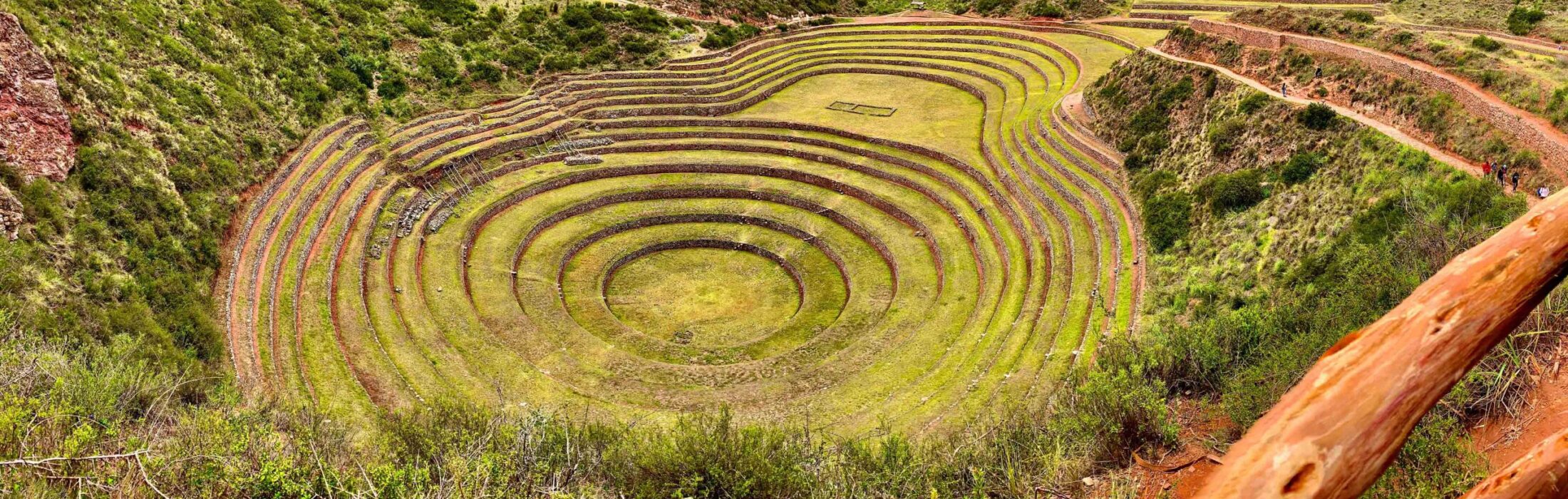
Moray is one of Peru’s most intriguing destinations, located in the Sacred Valley of the Incas, near the city of Cusco. This ancient archaeological site is known for its impressive circular terraces that resemble a complex farming system, but its purpose and functionality remain a mystery to many archaeologists and experts. Here we tell you everything you need to know about Moray and why it is a must-see for travelers.
The terraces of Moray are the most outstanding feature of the site. What makes Moray unique is its circular design and the staggered arrangement of its platforms. These terraces, of different sizes and depths, allow for temperature variations and microclimates to be experienced at each level. Some experts believe that Moray was used as an agricultural laboratory by the Incas, where they experimented with different crops to see how they adapted to different altitudes and climates. Others suggest that it was a center for the production of special crops, such as quinoa, potatoes or corn.
The structure of the terraces allows precise control of temperature and humidity, which would have been crucial for ancient Inca farmers. This demonstrates the advanced level of knowledge the Incas had about agriculture and natural resource management.
Moray is located about 50 kilometers northwest of Cusco, in the district of Maras. The site is surrounded by a spectacular landscape of mountains, valleys and agricultural fields, making it an ideal place to learn about the Incas’ connection with nature. From Moray, travelers can enjoy breathtaking views of the Sacred Valley, an area known for its beauty and historical importance.
A few kilometers from Moray are the salt mines of Maras, another fascinating destination that you can visit in the same day. The salt mines are a set of small pools where salt water from a subway stream is channeled and evaporated to obtain salt. This ancestral method has remained practically intact since the time of the Incas. The pools, which are dyed white with salt and contrast with the green of the surrounding fields, create an impressive landscape worth exploring.
Access to Moray is relatively easy from Cusco. Travelers can take an organized tour that will take them to the main attractions of the Sacred Valley, including Moray and the salt mines of Maras. It is also possible to arrive by public transport or cab, although it is recommended to hire a guide to better understand the history and significance of the site.
Wear comfortable clothes: Moray is located at a considerable altitude, so it is important to be prepared to walk on uneven and, in some cases, steep terrain.
Acclimatization: Since Cusco and the Sacred Valley are at high altitude, it is advisable to spend at least one day in Cusco to acclimatize before visiting Moray and other sites.
Sun protection: Although Moray is in the Sacred Valley, the altitude and strong sun can quickly cause sunburn, so bring sunscreen and a hat.
Water: It is important to stay hydrated during your visit, as the hikes can be demanding, especially in hot weather.
Moray is an archaeological jewel that shows the innovation and knowledge of the Incas about agriculture. This site is not only fascinating for its history, but also for the natural beauty that surrounds it. If you are traveling through the Sacred Valley or Cusco, you can not miss Moray and immerse yourself in the mystery of its circular terraces. A place where history, culture and nature merge, offering a unique experience that will leave you in awe.